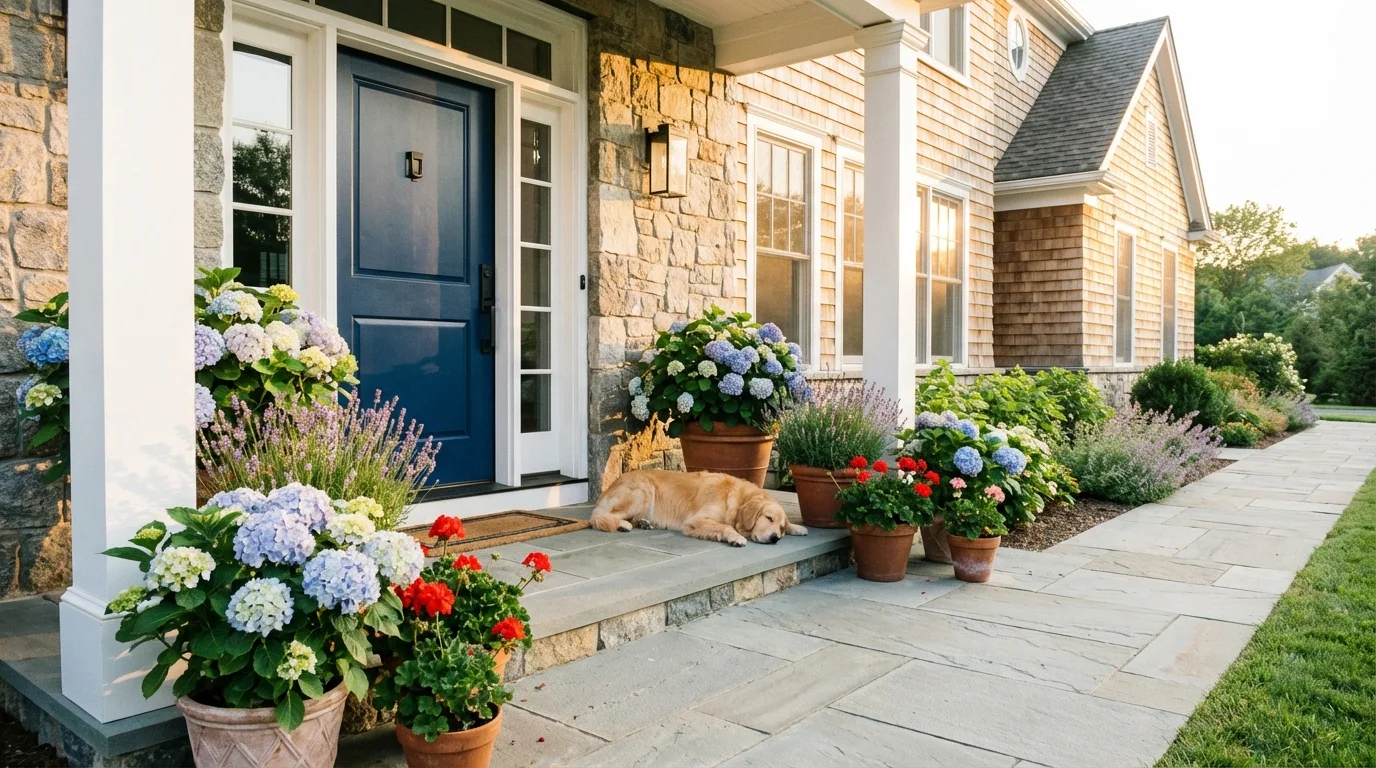
A tired front of house usually comes down to four things: a stained driveway, a faded door, numbers nobody can read and dark, bare beds. You can fix all four for under $500 and a few weekends of work, without hiring a contractor.
Wash first, then paint and swap hardware, then add numbers and light. Plant last so nothing new gets sprayed, splattered or trampled.
What each upgrade costs and who should do it
These ranges cover materials and rentals for a typical single-family front or a rowhouse stoop. Few homes need every row, so start with whichever fixes your worst problem.
| Upgrade | Typical cost | Time | DIY or pro |
|---|---|---|---|
| Pressure wash driveway, walk and siding | $50 to $90 per day (rental) | 1 day | DIY on one story; pro for second-story siding |
| Paint the front door | $40 to $60 | Half day plus drying | DIY; test for lead first in pre-1978 homes |
| Replace the handleset | $120 to $200 | 1 to 2 hours | DIY |
| Floating house numbers | $40 to $80 | 1 hour | DIY |
| Mailbox repaint or replacement | Under $20 to repaint; about $100 new | 1 to 3 hours | DIY; call 811 before digging |
| Porch sconces (pair) | $150 to $300 | 2 hours | DIY on existing boxes; electrician for new wiring |
| Solar path lights (6 to 8) | $80 to $120 | 1 hour | DIY |
| Edging and mulch | $40 to $75 | Full day | DIY |
| Two filled door planters | $80 to $150 | 2 hours | DIY |
If you only do two things, wash and paint the door. Together they cost about $100 to $150 and change how the whole facade reads from the street.
Wash the driveway, walk and siding first
A pressure washer rents for about $50 to $90 a day at most home centers. For concrete, ask for a surface cleaner attachment: the spinning disc cleans evenly and avoids the stripes a wand leaves.
Use the 25-degree green tip on concrete and the 40-degree white tip or the soap nozzle on siding. Never use the 0-degree red tip on a house; it can gouge wood, etch concrete and blow mortar out of brick joints.
Siding needs a soft wash, not force. Apply house-wash detergent with the low-pressure soap nozzle, let it sit about 10 minutes, then rinse top to bottom with a wide fan, always aiming down so water never gets driven behind vinyl laps.
Wear eye protection and closed shoes, and never run a pressure washer from a ladder, because the recoil can pull you off. For second-story siding, use an extension wand from the ground or hire a pro.
The same rental can clean a deck or patio the same weekend; our deck and patio maintenance schedule covers the gentler settings wood needs.
Repaint the front door and replace its hardware
The door is the smallest surface on the facade and the one everyone touches, so it can carry a bold color. Navy, charcoal, black or a red that contrasts with gray siding or brick all work; check HOA rules before you buy.

Painting the door in a day
A quart of exterior enamel, a fine foam roller, a 2-inch angled brush and painter’s tape cost about $40 to $60. Choose semi-gloss or high-gloss exterior paint; flat finishes hold dirt, and interior paint breaks down in sun and rain.
- Remove the knob, deadbolt, kick plate and knocker, and bag the screws.
- Wash the door with a degreasing cleaner, rinse, and lightly sand with 120-grit paper so the new coat grips. Wipe off all dust.
- Prime bare wood, bare fiberglass, patched spots or any big dark-to-light change with exterior bonding primer.
- Brush the panel recesses first, then roll the flat areas. Apply two or three thin coats and respect the recoat time on the can.
- Check the label’s minimum temperature, and paint on a dry day so the door can stay ajar while it cures.
- Rehang the hardware and replace any cracked or flattened weatherstripping.
If your home was built before 1978, the old paint on the door and trim may contain lead. Test it or hire a certified renovator before sanding, and follow the EPA’s lead-safe practices for DIY renovation: contain the dust, mist surfaces and skip power sanding.
Push a screwdriver into the bottom rail and the jamb while the hardware is off. If it sinks into soft wood beyond a small patchable spot, have a carpenter replace it rather than painting over rot.
Choosing a handleset that lasts
Budget $120 to $200 for a solid-metal handleset with a matching deadbolt in matte black, satin nickel or brushed brass. Before buying, measure the backset (usually 2-3/8 or 2-3/4 inches), the bore (usually 2-1/8 inches) and door thickness.
Look for a BHMA grade on the box: under ANSI/BHMA A156.39, residential locksets are rated Grade A, B or C for security, durability and finish, with A the highest. Our door hardware upgrade guide walks through the swap.
Make the house number and mailbox easy to read
Numbers are a safety item before they are decor, because responders have to find you at night. The International Residential Code calls for address numbers in Arabic numerals or letters at least 4 inches high, contrasting with their background and legible from the street.
Builder numbers often just meet that minimum. Floating numbers 5 to 7 inches tall, mounted about 1/2 inch off the wall on spacers, read better and cast a crisp shadow for about $40 to $80 a metal set.

A sound but weathered metal mailbox needs only a wire brush, light sanding, tape over the flag and two coats of rust-preventive spray enamel, all for under $20. A new box runs about $100.
If the post leans or you are replacing it, follow USPS mailbox placement rules: 41 to 45 inches from the road surface to the mail entry, with the front of the box 6 to 8 inches back from the curb.
Call 811 a few days before digging, then set a pressure-treated 4×4 in fast-setting concrete.
Light the entry and the walk
Porch sconces should be roughly one-quarter to one-third the height of the door, so a standard 80-inch door takes fixtures about 20 to 27 inches tall. Undersized lights are the most common reason an entry looks dated after dark.
A pair of weather-rated sconces costs about $150 to $300. Measure the old canopy so the new backplate covers the paint line, and buy fixtures rated for wet locations if rain reaches them.
Shut off the breaker, confirm the wires are dead with a non-contact voltage tester and work from a stepladder on firm, level ground. If you find crumbling insulation, knob-and-tube wiring, no ground wire or no junction box, stop and call a licensed electrician.
Use warm-white LED bulbs at 2700K to 3000K; 4000K and above looks harsh against most siding and brick. Our layered lighting guide explains color temperature in more depth.
For the walk, solar LED path lights need no wiring, and six to eight glass-and-metal fixtures cost about $80 to $120. Space them 6 to 8 feet apart and stagger them on alternating sides instead of lining both edges like a runway.

Edge, mulch and plant the beds by the door
Cut a clean edge before you mulch. A half-moon edger or flat spade makes a 3- to 4-inch-deep vertical cut between lawn and bed; lift out the sod strip and the line holds for most of a season.
Penn State Extension recommends a 2- to 3-inch layer of organic mulch, pulled back from tree trunks rather than heaped against them. Keep it off shrub stems too.
A 2-cubic-foot bag covers about 12 square feet at 2 inches deep. A 150-square-foot foundation bed takes about 13 bags, or $40 to $75.
Flank the door with two matching planters at least 16 inches across, with drainage holes. Fill each with a thriller, filler and spiller: a dwarf conifer or upright grass in the center, coleus or begonias around it, and creeping Jenny or trailing ivy at the rim.

Match plants to the light your entry actually gets; a north-facing door needs shade lovers. Add bed cleanup and pot storage to your fall prep using our room-by-room winterizing guide so the planters survive freezing weather.
How $500 splits for a driveway-and-beds front
Here is one budget for a single-family home with a two-car concrete driveway, a 150-square-foot foundation bed and porch lights that still work, using figures within the cost table’s ranges.
| Item | Cost | Why it made the list |
|---|---|---|
| Pressure washer rental | $75 | The driveway is the largest visible surface |
| Door paint and supplies | $50 | Biggest change per dollar |
| Handleset | $150 | Grade-rated lock with matching deadbolt |
| House numbers | $60 | Readable from the street at night |
| Solar path lights | $100 | Lights the walk without wiring |
| Mulch and edging | $60 | 13 bags for the foundation bed |
| Total | $495 |
Keeping the existing sconces frees money for the walk and the beds. If the house was built before 1978, add a $25 lead test kit before sanding the door and drop to a $125 handleset to stay at $495.
Facade jobs that need a pro or a pass
- Large limbs over the roof or driveway. Hire an insured tree service, and never run a chainsaw from a ladder.
- Rot beyond a small patch. A carpenter should replace soft jambs or trim before any paint goes on.
- New light locations. Adding a fixture where no box exists is electrician work and often needs a permit.
- Widespread peeling paint on a pre-1978 house. That calls for an EPA-certified renovator, not a weekend scraper.
- Porch decor overload. Skip extra flags, multiple wreaths and mismatched chairs; one bench, a doormat and two planters read cleaner from the street.
When the work is done, stand at the curb at dusk. If you can read the number, see the door color and follow the lit path to the step, the $500 went where it should.