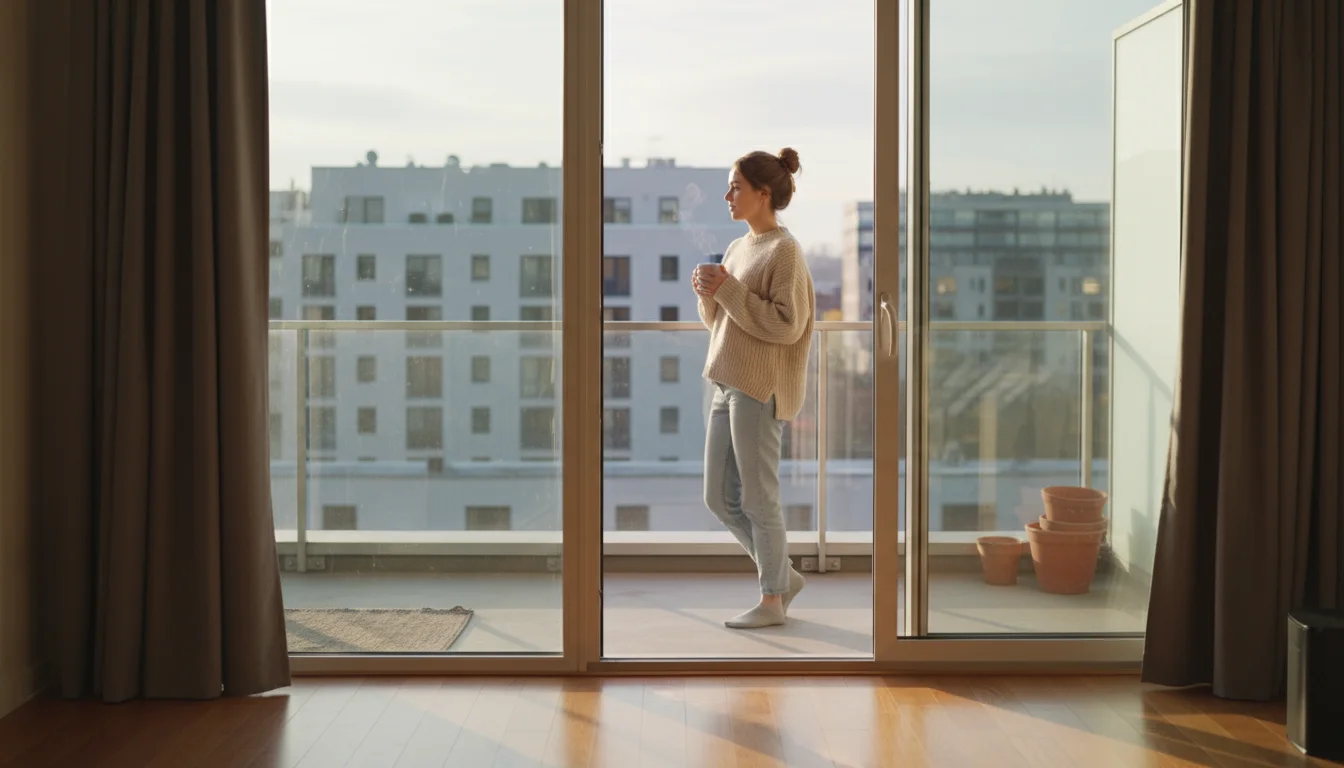
Standard patio furniture assumes a deck, not a ledge. On a balcony only 3 to 6 feet deep, a round table and two armchairs block the door, and the first summer storm can send a cushion three floors down.
Buy for depth first, keep heavy pots against the building, choose plants for the sun you actually get, and check your lease and fire code before anything with a flame goes outside.
Measure the depth, the door path and the sun first
Measure from the building wall to the inside of the railing, and note how far the balcony door swings out. What remains after a clear path from the door is your usable furniture zone.
Keep at least 18 to 24 inches clear in front of the door so you can step out carrying a plate or a watering can. Sliding doors need less room, but the track and threshold must stay unobstructed.
Then spend one day noting when direct sun reaches the floor. Compass direction is a shortcut, but neighboring towers, the balcony above or a solid railing can turn a south-facing balcony into part shade.
If street noise is what keeps you indoors, a balcony upgrade won’t solve it alone; our guide to reducing noise in your apartment covers the window and door fixes that do.
Furniture sized for a shallow balcony
Plan the floor like a depth budget. Add up the inches each piece takes from wall to railing, and keep the total below your measured depth with the walking path included.
| Item | Depth it uses | Notes |
|---|---|---|
| Railing or wall-mounted drop-leaf table | 10-16 in | Floor stays clear; folds flat when down |
| Folding bistro table | 20-24 in | Look for tops under 24 in deep |
| Folding chair, occupied | 24-30 in | Table edge to the back of the seated person |
| Backless stool, pushed under a table | 0 in extra | Best for balconies under 3 ft |
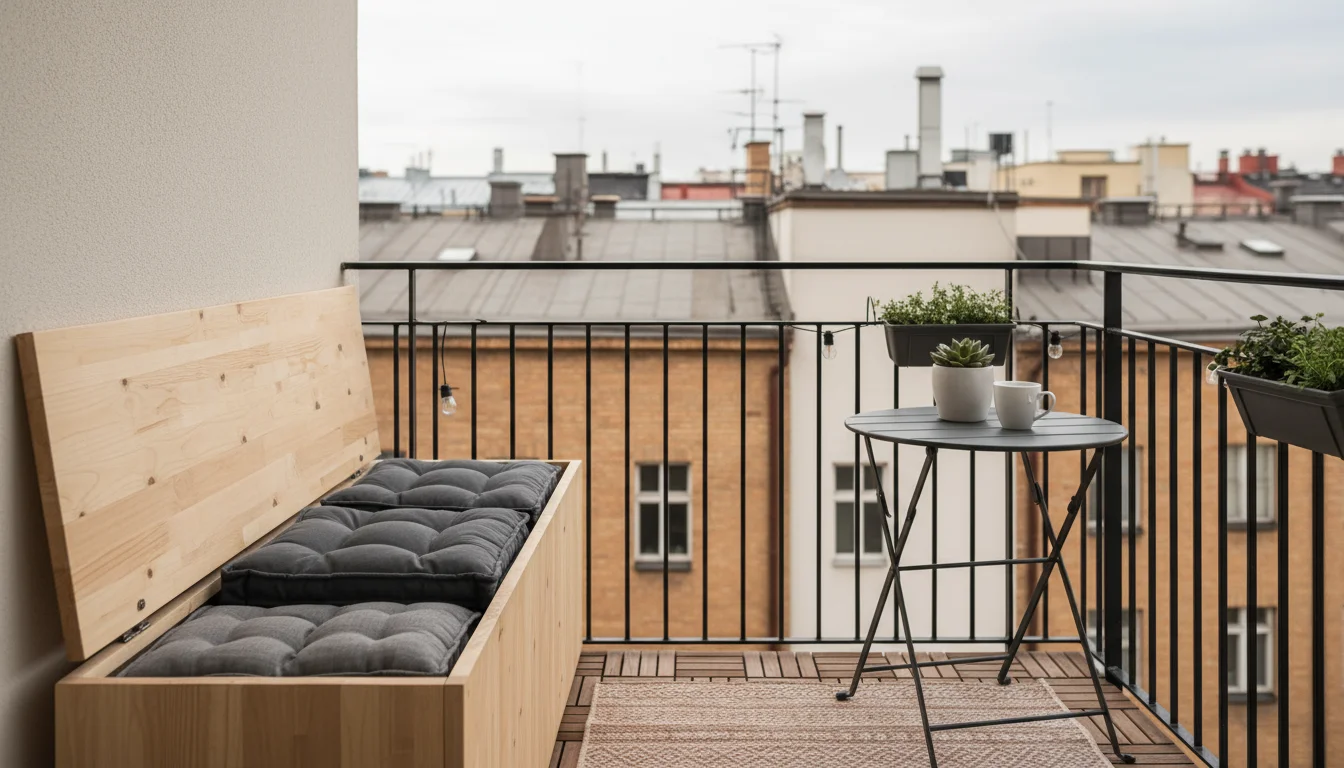
| Storage bench along the wall | 15-20 in | Seating plus a dry spot for cushions |
| Railing planter hung inside the rail | 6-10 in | Many leases ban planters hung outside the rail |
| Clear walking path | 18-24 in | Allow 36 in for a walker or wheelchair |
Balconies under 3 feet deep
Skip the table-in-the-middle layout. Mount a drop-leaf or clamp-on table on the railing or wall and face one or two stools toward it, so a seated person uses the depth instead of furniture.
On a 32-inch-deep, 8-foot-long upper-floor balcony, a 12-inch railing table leaves about 20 inches to walk when the stool is pushed under.
With someone seated, it becomes a one-person coffee spot, which is what that depth holds. At that height, the clamp-on table and stool also need the wind precautions covered below.
Use the length instead: a slim storage bench at the far end holds cushions and a watering can, and a few rail planters fill the opposite end without touching the floor.
Balconies 4 to 6 feet deep
Here a folding bistro set fits with room to move. IKEA’s TÄRNÖ folding table measures 21 5/8 by 21 1/4 inches, a useful benchmark for how small a two-person table can be.
Push the table against the railing and set the chairs on either side facing each other, so neither chair lands in the door path. On 5 to 6 feet, a wall bench plus a small folding table seats three.
Pieces that fold flat or hide storage earn their space, the same logic covered in our guide to multifunctional furniture for small homes.
Choose powder-coated aluminum, teak, oiled acacia or resin wicker. Very light aluminum chairs blow around, so pick models that fold flat and can hang on wall hooks.
Plants and layout by sun exposure
Count hours of direct sun, not brightness. Colorado State University Extension lists cacti, succulents, petunias and verbena for sunny exposures, and dracaena, schefflera and impatiens for shade.
The table below assumes a Northern Hemisphere balcony.
| Exposure | Plants that fit | Narrow (under 3 ft deep) | Square (4-6 ft deep) |
|---|---|---|---|
| North / shade (under 3 hrs direct sun) | Impatiens, ferns, coleus, begonias; dracaena or schefflera moved out for summer | Rail boxes of impatiens or coleus; one fern in a corner | Cushioned bench or bistro set; foliage grouped in large pots |
| East / morning sun (3-6 hrs) | Parsley, mint, chives, lettuce, begonias, fuchsia | Herb and lettuce rail boxes; wall shelf at the bright end | Breakfast bistro set; trough of salad greens along the wall |
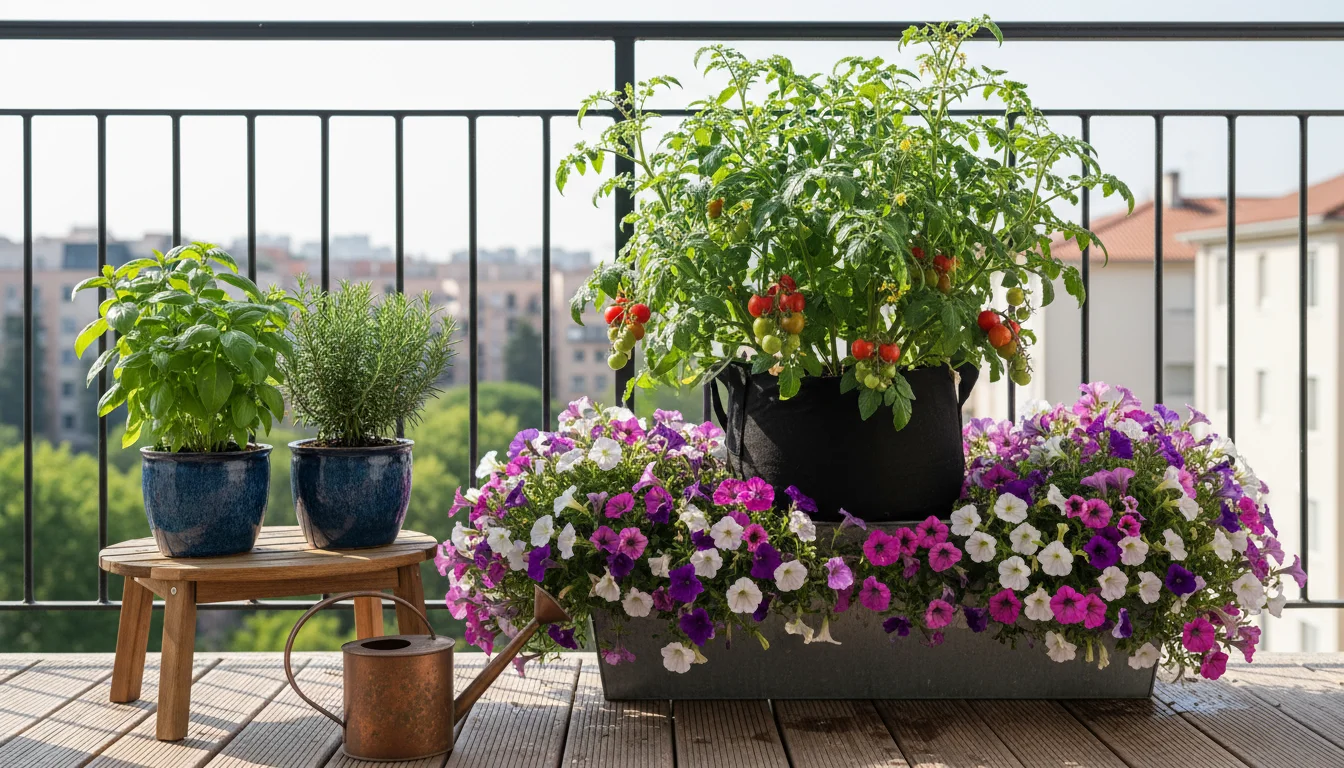
| South or west / full sun (6+ hrs) | Tomatoes, peppers, basil, rosemary, petunias, verbena, succulents | One self-watering tomato pot at the wall; succulents on the rail | Weighted umbrella or shade sail if allowed; vegetable containers against the wall |
West-facing balconies take hot afternoon sun that bounces off concrete and glass. Expect to water small pots daily in midsummer, or switch to succulents and verbena.
Use bigger containers than seem necessary. A tomato needs 5 gallons of soil or more, and a 12-inch pot dries out far slower than a 6-inch one.
Tiered stands and wall shelves add growing room without floor space; see our vertical storage ideas.
How much weight your balcony can carry
Codes set a minimum design load. The International Building Code requires multifamily balconies to be designed for 1.5 times the live load of the area they serve, which works out to 60 pounds per square foot for apartments.
That figure assumes weight spread evenly over a balcony in good repair. It is not permission to stack soil bags, and older or corroded balconies may carry less.
Wet soil is the heavy item. Group large planters against the building wall, where balconies are supported, rather than along the outer railing, and keep raised beds, water features and hot tubs off unless the landlord approves in writing.
Report cracked concrete, rust stains running from the slab edge, wobbly railing posts or a floor that tilts toward the rail. Stay off the balcony until the owner has a licensed structural engineer inspect it.
Grills, flames and fire-code rules
The NFPA 1 Fire Code restricts charcoal and gas grills, hibachis and similar open-flame cooking and heating appliances on apartment balconies. Many cities and leases ban them outright, including storing a propane tank outside.
Electric is the usual exception. A revision to NFPA 1 permits UL 1026-listed electric grills on multifamily balconies when operated according to the manufacturer’s instructions, but your local code edition and lease still decide.
Plug grills and string lights only into a GFCI-protected outdoor outlet, using a cord rated for outdoor use and the appliance’s wattage. If there is no outlet, ask the landlord; adding one is a job for a licensed electrician.
Candles, fire bowls and tabletop fire pits raise the same open-flame concerns, and battery LED lanterns give the glow without the risk. Our candle safety guide covers flame use indoors.
If your balcony doubles as a fire escape or second exit, store nothing on it and keep the path to any ladder or hatch completely clear.

Securing furniture, pots and lights against wind
Wind tends to strengthen with height and funnel between buildings, so an upper-floor balcony needs more anchoring than a ground-level patio.
- Choose stable pot shapes. University of Illinois Extension recommends broad-based square or cylindrical containers rather than inverted cone shapes where wind is a concern.
- Fix rail planters from the inside. Use brackets or heavy zip ties, and hang baskets on closed-eye hooks rather than open S-hooks.
- Fold and hang light chairs. Wall hooks keep them off the floor and out of the wind; store cushions in a lidded deck box or indoors.
- Close umbrellas every time you go in. Use the heaviest base the pole accepts, or a clamp-on balcony umbrella or shade sail instead.
- Clip string lights every few feet. Loose runs whip against glass and railings.
When a wind advisory or high wind warning is issued, bring in anything you can lift with one hand, lay tall plants on their sides, and untie fabric privacy screens from the railing.
Watering without soaking the neighbors below
Water draining through pots drips onto the balcony underneath, usually carrying soil. Set every pot in a saucer, or in a tray of gravel that catches runoff while keeping roots out of standing water.
Water slowly in early morning and stop when the first drops reach the saucer. Empty saucers after rain so they don’t breed mosquitoes.
Self-watering pots with a reservoir cut both runoff and daily watering on hot, sunny balconies. Sweep rather than hose the floor, since many buildings forbid hosing for the same reason.