

Opening your monthly utility statement does not have to be a stressful ritual. When drafty windows, aging appliances, and inefficient habits combine, they can quietly drain your bank account month after month. You might assume that significantly lowering your costs requires a massive, expensive overhaul—like installing solar panels or completely replacing your home’s insulation. The reality is far more practical. By methodically evaluating your living space and making targeted adjustments, you can realistically reduce energy bills by up to 30 percent.
Achieving this level of savings is about the cumulative power of small, intentional changes. Every room in your house possesses unique energy demands; the way you manage humidity in the bathroom directly impacts your HVAC system, just as the way you organize your refrigerator affects its compressor cycles. This comprehensive home energy efficiency guide will walk you through your home, outlining precisely where your electricity, gas, and water heating dollars are going and how you can reclaim them.

The Essentials: What You Will Learn
- How to eliminate “vampire” power loads that inflate your monthly costs.
- Practical adjustments for major appliances that cut electricity bill totals without sacrificing convenience.
- The connection between proper ventilation, humidity control, and heating/cooling efficiency.
- Which low-cost weatherization projects deliver the highest return on investment.
- How to optimize your utility spaces—the hidden areas where energy loss is most severe.

The Kitchen: Taming the Appliance Powerhouse
Your kitchen is likely the most energy-intensive room in your home. It houses appliances that run continuously, devices that generate massive amounts of heat, and tools that use significant volumes of water. Managing this room effectively is your first major step toward lower home energy costs.
If you are planning an upgrade, choosing the best energy-efficient appliances can lead to even greater long-term savings.
Let us begin with the refrigerator, the only appliance in your home that works 24 hours a day, seven days a week. The way you pack and maintain your fridge has a direct impact on its energy consumption. Refrigerators operate most efficiently when they are adequately stocked but not overfilled. The food and liquids inside act as thermal mass; once they are cooled, they help maintain the internal temperature, meaning the compressor does not have to work as hard when you open the door. However, if you pack the shelves so tightly that cold air cannot circulate, the appliance will burn extra electricity trying to distribute the chill. Aim to keep your refrigerator at 37 degrees Fahrenheit and your freezer at 0 degrees Fahrenheit, which Energy Star recommends as the optimal balance between food safety and energy conservation.
Furthermore, pull your refrigerator away from the wall twice a year to vacuum the condenser coils. When these coils are coated in dust and pet hair, they cannot release heat effectively, forcing the motor to run longer and draw more electricity.
Your dishwasher is another prime candidate for optimization. Most of the energy used by a dishwasher goes toward heating the water. You can bypass a significant portion of this energy draw simply by turning off the “heated dry” setting. Opening the door a few inches after the final rinse cycle allows the dishes to air dry naturally, saving up to 15 percent of the dishwasher’s total energy usage. Always wait until you have a full load before running the machine; running two half-loads consumes twice the water and energy.
When it comes to cooking, match your appliance to the size of your meal. Firing up a massive conventional oven to bake two potatoes is a tremendous waste of resources. Whenever possible, utilize smaller countertop appliances like microwaves, toaster ovens, or air fryers. These devices heat up much faster and use a fraction of the electricity required by a full-sized electric or gas range. If you must use the oven, resist the urge to open the door to check on your food—every time you do, the temperature drops by up to 25 degrees, forcing the element to draw more power to recover the heat.

The Living Room: Eliminating Vampire Loads and Controlling Climate
The living room is typically the center of entertainment and relaxation, but it is also a primary location for “phantom” or “vampire” energy loads. Many electronics—including televisions, cable boxes, gaming consoles, and sound systems—continue to draw power even when turned off. They remain in standby mode, waiting for a signal from a remote control or downloading background updates.
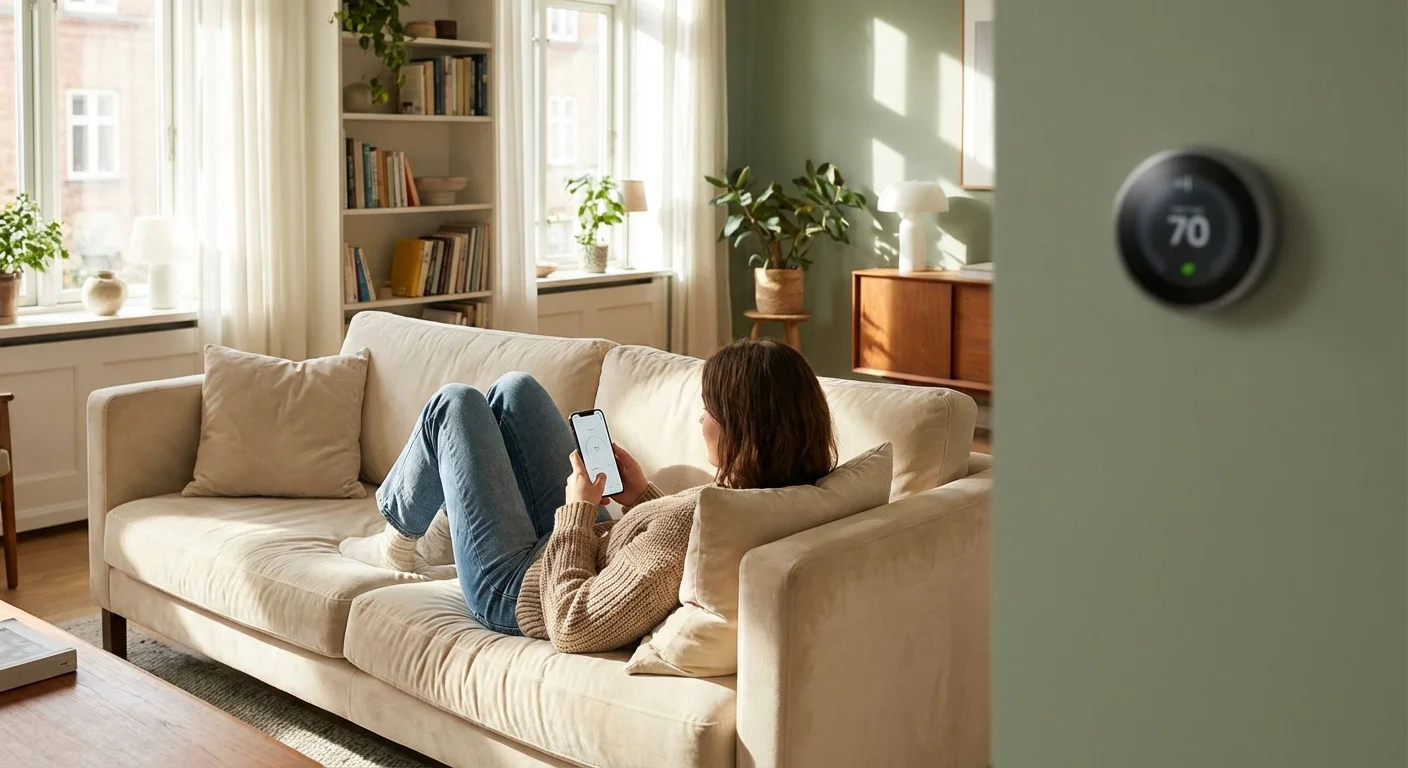
Integrating smart home devices is another effective way to automate your savings and monitor real-time usage.
To combat this hidden drain, group your entertainment devices onto a smart power strip. A smart strip detects when the primary device (like the television) is turned off and automatically severs the power connection to peripheral devices (like the soundbar and gaming console). This single intervention can prevent dozens of watts from bleeding into the grid unutilized, helping to cut electricity bill costs steadily over the year.
Beyond electronics, your living room’s climate control strategy heavily dictates your energy expenses. Large windows are beautiful, but they are also thermal liabilities. In the winter, up to 30 percent of a home’s heating energy is lost through windows. In the summer, solar heat gain forces your air conditioner to work overtime.
Installing thermal, insulated curtains or cellular shades provides a powerful barrier against this energy transfer. During hot summer days, close the treatments on south- and west-facing windows to block direct sunlight. In the winter, open them during the day to let the sun naturally warm the room, then close them tightly at dusk to trap that heat inside.
“A comprehensive approach to home energy efficiency—addressing both the building envelope and the equipment inside—can yield savings of 20 to 30 percent.” — Energy Star Guidelines
If you have a fireplace, ensure the damper is tightly closed when a fire is not actively burning. An open fireplace damper is essentially an open window, allowing the warm air your furnace just generated to escape straight up the chimney.

The Bathroom: Water Heating and Ventilation Dynamics
While the bathroom may be a smaller space, its impact on your utility bills is substantial, primarily due to hot water consumption. Heating water is the second-largest energy expense in the average home, accounting for roughly 18 percent of your utility bill.
The most effective intervention here is replacing old showerheads with modern, low-flow fixtures. Older models can pump out up to 5 gallons of water per minute, whereas current WaterSense-labeled showerheads use no more than 2 gallons per minute while still delivering robust water pressure through aeration technology. By cutting your hot water volume in half, you simultaneously reduce your water bill and your gas or electric heating bill.
Ventilation is another crucial aspect of bathroom energy management. Your bathroom exhaust fan is essential for removing moisture and preventing mold, but it is also highly efficient at pumping your expensively heated or cooled air right out of the house. Many people turn the fan on before a shower and forget it for hours. To prevent this, install a simple countdown timer switch for your bathroom fan. Set it for 20 minutes—enough time to clear the humidity without needlessly exhausting your climate-controlled indoor air.
Additionally, check the caulking around your bathroom windows and the weatherstripping on the door if it leads to an unconditioned space. Bathrooms experience extreme temperature and humidity fluctuations, which can cause conventional caulking to crack and peel faster than in other rooms, leading to subtle but persistent drafts.

The Bedroom: Achieving Comfort Without the Cost
We spend roughly a third of our lives in our bedrooms, yet we often over-condition these spaces. The key to reducing energy bills in the bedroom is shifting your focus from heating or cooling the entire room to heating or cooling yourself.
During the winter, lowering your thermostat by just 7 to 10 degrees Fahrenheit for the eight hours you sleep can save up to 10 percent on your heating bills. You can maintain perfect comfort by investing in high-quality flannel sheets, a down or down-alternative comforter, or a heated mattress pad. A heated mattress pad uses a minuscule fraction of the electricity required by a central furnace or a space heater, delivering targeted warmth exactly where you need it.
In the warmer months, ceiling fans are your best defense against high cooling costs. However, ceiling fans cool people, not rooms. They create a wind-chill effect that evaporates moisture from your skin, making you feel up to 4 degrees cooler. Ensure your fan is rotating counterclockwise in the summer to push a breeze straight down. Because fans do not actually lower the room’s temperature, you must remember to turn them off when you leave the bedroom; otherwise, you are simply wasting electricity to spin the motor.
Take a moment to evaluate your bedroom lighting. Because bedside lamps are frequently left on for reading or ambient light, replacing incandescent bulbs with LEDs is a mandatory energy saving tip. LEDs use up to 90 percent less energy and last 25 times longer. If you enjoy falling asleep with a light or television on, utilize sleep timers to ensure these devices power down once you are asleep.

The Laundry Room: Washing and Drying Smart
The laundry room is a hidden hub of energy consumption, but adjusting a few simple habits can yield immediate savings. The vast majority of the energy required to run a washing machine—up to 90 percent—goes toward heating the water. Switching your default setting from hot or warm to cold water can drastically lower home energy costs. Modern laundry detergents are explicitly formulated with enzymes that perform brilliantly in cold water, meaning your clothes will get just as clean without the thermal expense.
For more maintenance tips, follow our appliance cleaning guide to keep your machines running at peak efficiency.
When it comes to the clothes dryer, efficiency relies entirely on airflow. A dryer functions by passing heated air through tumbling clothes and exhausting the moisture-laden air outside. If that airflow is restricted, the machine has to run longer and hotter to dry the load. Always empty the lint filter before every single cycle. Beyond the filter, make it an annual habit to disconnect the exhaust hose from the back of the dryer and vacuum out the built-up lint. Not only will this drastically reduce drying times, but it also eliminates a severe fire hazard.
Consider introducing wool dryer balls to your routine. Tossed in with wet clothes, these balls separate the garments as they tumble, allowing hot air to circulate more effectively and reducing drying time by up to 25 percent. If your machine has an auto-moisture sensor, rely on it rather than the timed dry setting to ensure the dryer shuts off the moment the clothes are dry.
Of course, the ultimate energy-saving tip for the laundry room requires no electricity at all: utilize a drying rack or an outdoor clothesline whenever possible. Air drying completely circumvents the high energy draw of the appliance and helps your clothing last significantly longer.
The Basement, Attic, and Utility Spaces: Unseen Energy Hogs
While we do not spend much time living in them, our utility spaces dictate the overall energy performance of the house. The basement, attic, and garage are the front lines of your home’s building envelope—the physical separator between the conditioned indoor environment and the unconditioned outdoors.
Ensuring these areas are properly sealed is vital, so consider a room-by-room insulation audit to identify hidden air leaks.
Start with your HVAC system. A furnace or central air conditioner that is starved for air will consume excess energy while providing poor performance. Inspect your HVAC filters monthly and replace them at least every 90 days. A clogged filter forces the blower motor to work against heavy resistance, driving up your electricity bill and prematurely aging the equipment.
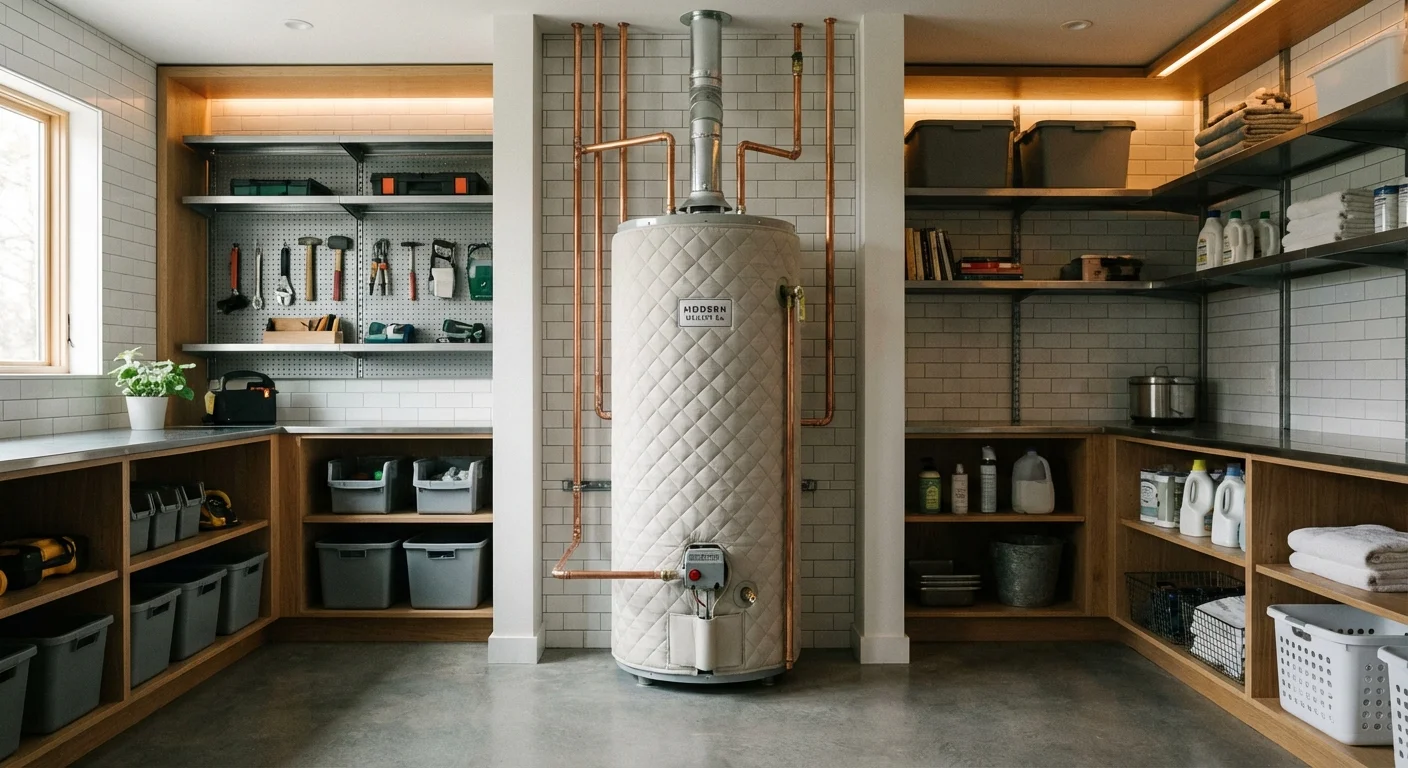
Next, locate your water heater. If you have a tank-style water heater, check the temperature setting. Manufacturers often set these tanks to 140 degrees Fahrenheit by default, which is unnecessarily hot for household use and increases standby heat loss. Lowering the dial to 120 degrees Fahrenheit provides plenty of hot water for showers and dishwashing while saving significant energy and reducing the risk of scalding. If your water heater tank feels warm to the touch, it is losing heat to the surrounding air. Wrapping it in an insulated water heater blanket can reduce standby heat losses by 25 to 45 percent.
Air sealing is perhaps the most critical step you can take in these utility spaces. Go to your unfinished basement or crawlspace and look at the rim joists—the perimeter where the wooden house frame meets the concrete foundation. This joint is notoriously leaky. Using expanding foam or rigid foam board to seal and insulate these gaps prevents freezing winter air from flowing under your floors.
Similarly, inspect the attic. Heat rises, and if your attic floor is poorly insulated or full of air leaks around recessed lighting fixtures, plumbing stacks, or the attic hatch, your expensive winter heating is literally going through the roof. According to experts at This Old House, sealing attic air leaks and adding proper insulation yields one of the fastest paybacks of any home improvement project.

Analyzing Your Investments: Energy Upgrade Comparison
To help you prioritize your efforts, use this table to understand the cost-to-benefit ratio of common energy-saving projects. Start with the low-cost interventions and work your way up as your budget allows.
| Energy Upgrades | Estimated Cost | DIY Feasibility | Potential Energy Savings Impact |
|---|---|---|---|
| Adjusting thermostat & water heater temps | Free | Very High | High (Immediate reductions) |
| Installing LED bulbs & smart power strips | $20 – $100 | Very High | Medium (Steady, passive savings) |
| Caulking & weatherstripping doors/windows | $30 – $75 | High | High (Drastic draft reduction) |
| Installing a Smart Thermostat | $100 – $250 | Medium | High (Optimizes usage based on schedule) |
| Air sealing rim joists and attic penetrations | $50 – $150 | Medium | Very High (Protects the building envelope) |
| Blowing new attic insulation | $1,000 – $2,500+ | Low to Medium | Very High (Major transformation of HVAC load) |

What Can Go Wrong: Avoiding Energy Efficiency Mistakes
While tightening up your home is generally a smart financial move, chasing energy efficiency without understanding building science can create unintended problems. The most common mistake homeowners make is over-sealing a house without accounting for ventilation. A house needs to “breathe” to expel indoor air pollutants, volatile organic compounds (VOCs), and moisture. If you seal every single gap without utilizing proper mechanical ventilation (like exhaust fans or an energy recovery ventilator), you can trap excessive humidity indoors, leading to condensation on windows, mold growth inside walls, and poor indoor air quality.
Another frequent error occurs in the attic. When homeowners lay down new fiberglass batt insulation or spray expanding foam, they sometimes accidentally block the soffit vents at the edges of the roofline. These vents are crucial; they allow cold outside air to flow under the roof deck and exit through the ridge vent, preventing ice dams in the winter and extreme heat buildup in the summer. Always ensure insulation baffles are installed to keep these airways clear.
Finally, beware of using the wrong HVAC filters. It is tempting to buy the filter with the highest MERV rating available, assuming it will purify the air perfectly. However, highly dense filters restrict airflow so severely that older furnaces cannot push air through them. This starves the system, causing the heat exchanger to overheat, potentially cracking it and destroying the furnace entirely. Always consult your HVAC system’s manual to find the maximum MERV rating your specific blower motor can handle.

When to Call a Professional
While installing weatherstripping and changing showerheads are weekend DIY projects, certain energy upgrades require professional expertise to ensure safety and effectiveness.
- Comprehensive Energy Audits: If your bills remain stubbornly high after making basic changes, hire a certified home energy auditor. They use specialized equipment, such as blower doors and infrared thermography cameras, to pinpoint exactly where your home is leaking heat and cooling.
- HVAC Servicing and Duct Sealing: You should have a professional inspect your furnace and air conditioning systems annually to check refrigerant levels, clean the blower motor, and inspect the heat exchanger. Furthermore, if your ductwork runs through an unconditioned attic or crawlspace, a professional can seal the seams with mastic and insulate the ducts to prevent you from heating your crawlspace instead of your living room.
- Electrical Panel and Wiring Upgrades: If you are moving toward electrification—such as replacing a gas water heater with a highly efficient heat pump water heater—you may need more electrical capacity. Upgrading an electrical panel is incredibly dangerous and must be handled by a licensed electrician.
- Major Insulation Projects: While laying a few batts of fiberglass is straightforward, blowing in loose-fill cellulose across a large attic or injecting foam into existing wall cavities requires professional equipment and precise calculations to avoid moisture problems.
Frequently Asked Questions
Do smart thermostats actually save enough money to justify their cost?
Yes, in most cases. A smart thermostat learns your routine and optimizes heating and cooling patterns, ensuring you are not aggressively conditioning an empty house. According to Consumer Reports and energy studies, users typically save 10 to 12 percent on heating and 15 percent on cooling, often allowing the device to pay for itself within the first two years.
Should I replace my old drafty windows to save energy?
Replacing old, single-pane windows will certainly improve comfort and energy efficiency, but it is rarely the most cost-effective first step. Window replacement is incredibly expensive, and the return on investment through energy savings alone can take decades. You are almost always better off spending that money on air sealing and attic insulation first. If your windows are drafty, try repairing the glazing, adding robust weatherstripping, or installing storm windows at a fraction of the cost.
Does unplugging small appliances like toasters and coffee makers really help?
While older appliances used to draw phantom power, modern small kitchen appliances with mechanical switches (like a basic toaster) do not use electricity when turned off. However, devices with digital clocks, programmable timers, or “smart” internet connectivity do draw a small amount of continuous power. Unplugging them will save a few pennies, but your effort is better spent managing the vampire loads in your entertainment center and home office.
How can I tell if my home is poorly insulated?
Common signs of inadequate insulation include fluctuating temperatures between rooms, exceptionally cold floors in the winter, walls that feel cold to the touch, and ice dams forming on your roof gutters after a snowfall. High utility bills compared to neighbors with similarly sized homes are also a strong indicator.
Taking Charge of Your Home’s Energy Use
Reducing your home’s energy consumption is not a single event; it is an ongoing process of awareness and maintenance. By moving room by room, you can identify the inefficiencies that are quietly draining your resources. Start with the simplest behavioral changes—washing in cold water, adjusting the thermostat, and fully utilizing window treatments. Once those habits are established, you can confidently invest in physical upgrades like air sealing, LED lighting, and insulation improvements.
Every step you take builds upon the last, leading to a more comfortable living environment and significantly lower utility costs. The tips in this article are meant as general guidance. Your specific situation—including your home’s age, layout, and local building codes—may require different approaches. When in doubt, consult a professional to ensure your home operates as safely and efficiently as possible.
Last updated: February 2026







Leave a Reply