
Most laundry rooms break down in the same places: dirty clothes land on the floor, supplies crowd every flat surface, and there is nowhere to fold. Adding more baskets rarely fixes it.
Giving each step of the job its own spot does.
Set up four zones: sorting, washing and drying, treating and folding, and storage. Size them to your machines and keep chemicals high and closed.
The same layout works in a full room or a hallway closet.
How laundry moves from hamper to drawer
Laundry moves in one direction. Dirty clothes arrive, get sorted, washed, dried, treated or folded, then leave.
When two steps share a surface, such as folding shirts on a dusty dryer lid beside a dripping stain spray, the room stops working.
Before buying anything, empty the room and find the bottleneck. Overflowing hampers point to a sorting problem.
Clean baskets that sit for days mean you lack a folding surface.
Space and clearances for each laundry zone
The figures below are typical ranges. Confirm your machines’ exact width, depth and required clearances on the maker’s spec sheet before you build anything around them.
| Zone | What lives there | Space to plan | Fixture that fits |
|---|---|---|---|
| Sorting | 2 to 4 hampers or hanging bags | 16 to 24 in of wall or floor per bin; a 36 to 48 in rail holds three bags | Divided hamper or wall rail with canvas bags |
| Washing and drying | Washer and dryer | Full-size front-loaders are about 27 in wide each (54 to 60 in side by side); compact units about 24 in. A full-size stack stands roughly 76 to 80 in tall | Maker’s stacking kit, metal dryer duct |
| Treating and folding | Stain sprays, clean laundry in progress | Folding surface at least 36 in wide | Counter over front-loaders or wall-mounted drop-leaf table |
| Storage | Detergent, pods, tools, spare supplies | Shelves 10 to 12 in deep; lowest shelf about 18 to 24 in above machine tops | Wall shelves, latched cabinet, turntables, over-door rack |
The 36-inch minimum for folding follows laundry layout guidance that calls for a folding surface at least 3 feet wide, plus tall storage for detergent and room to hang clothes.
Sorting bins that match how you actually wash
Sort clothes the moment they enter the room, not on wash day. Dumping everything on the floor to separate it wastes time and puts dirty laundry in your workspace.
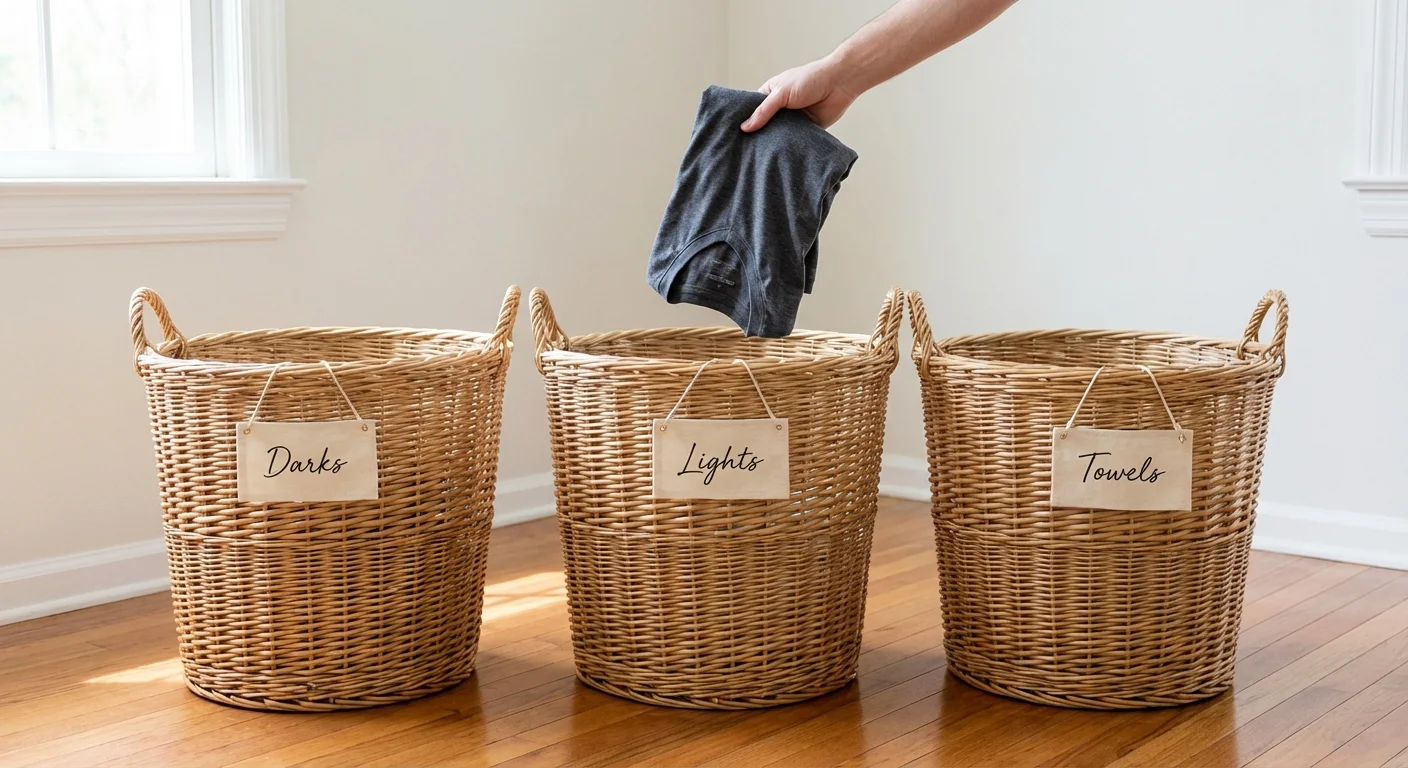
- Darks: jeans, black tees and dark sweaters that go in cold water to limit fading.
- Lights: white tees, underwear and light socks that can take warm water.
- Towels and bedding: heavy items that need long, hot drying. Mixed with light clothing, towels come out damp and shirts come out over-dried.
- Delicates: activewear, knits and anything that needs a gentle cycle or air drying.
No room for four bins? Use two, clothing and linens, and do the finer sorting at the machine.
The goal is the same: dirty laundry stays contained and off the floor.
Where floor space is tight, hang canvas laundry bags from a wall rail or pegboard and label each one. When a bag is full, unhook it and empty it straight into the washer.
Never drop damp towels or sweaty gym clothes into a closed hamper, where they mildew. Drape them over the hamper edge or a hook until dry.
If the laundry area doubles as your back entry, a mudroom drop zone keeps muddy gear out of the clothing bins.
Storage above and beside the machines
The wall above a washer and dryer is usually the largest unused space in the room. Run shelves from about 18 to 24 inches above the machines up toward the ceiling, anchored into studs, as covered in our floating shelf installation guide.
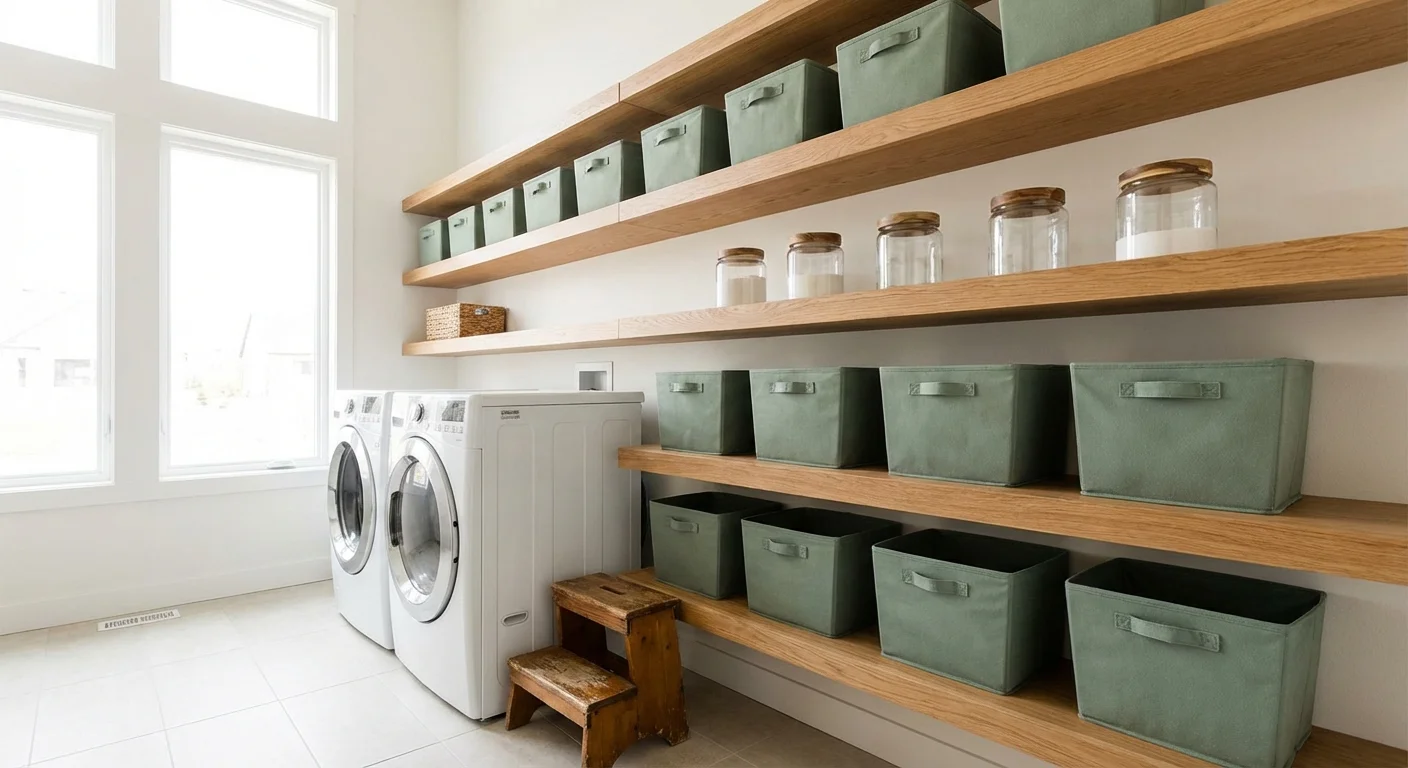
Put everyday items like stain sticks and dryer balls on the lowest shelf. Seasonal and backup items go up top, reached with a folding step stool that slides between the washer and the wall.
Heavy jugs never go overhead. Lifting a 150-ounce detergent jug above your head invites spills and strained shoulders, so keep bulk liquids in a base cabinet or on a turntable in a deep cupboard.
Measure the gaps between machines and walls. A slim rolling cart 5 to 7 inches wide fits many of them and holds dryer sheets, softener bottles and scrub brushes.
A magnetic bin on the dryer’s side catches lint without a floor trash can.
The back of a hinged door can take a track rack with adjustable baskets for lint rollers, mesh delicates bags and a sewing kit. It needs no wall anchors.
Folding and drying surfaces in the room you have
Side-by-side front-loaders can take a continuous counter of butcher block or laminated board. Leave at least 1 inch of space above the machines so spin-cycle vibration doesn’t knock the counter, and support it on wall cleats or end panels, not the machines.
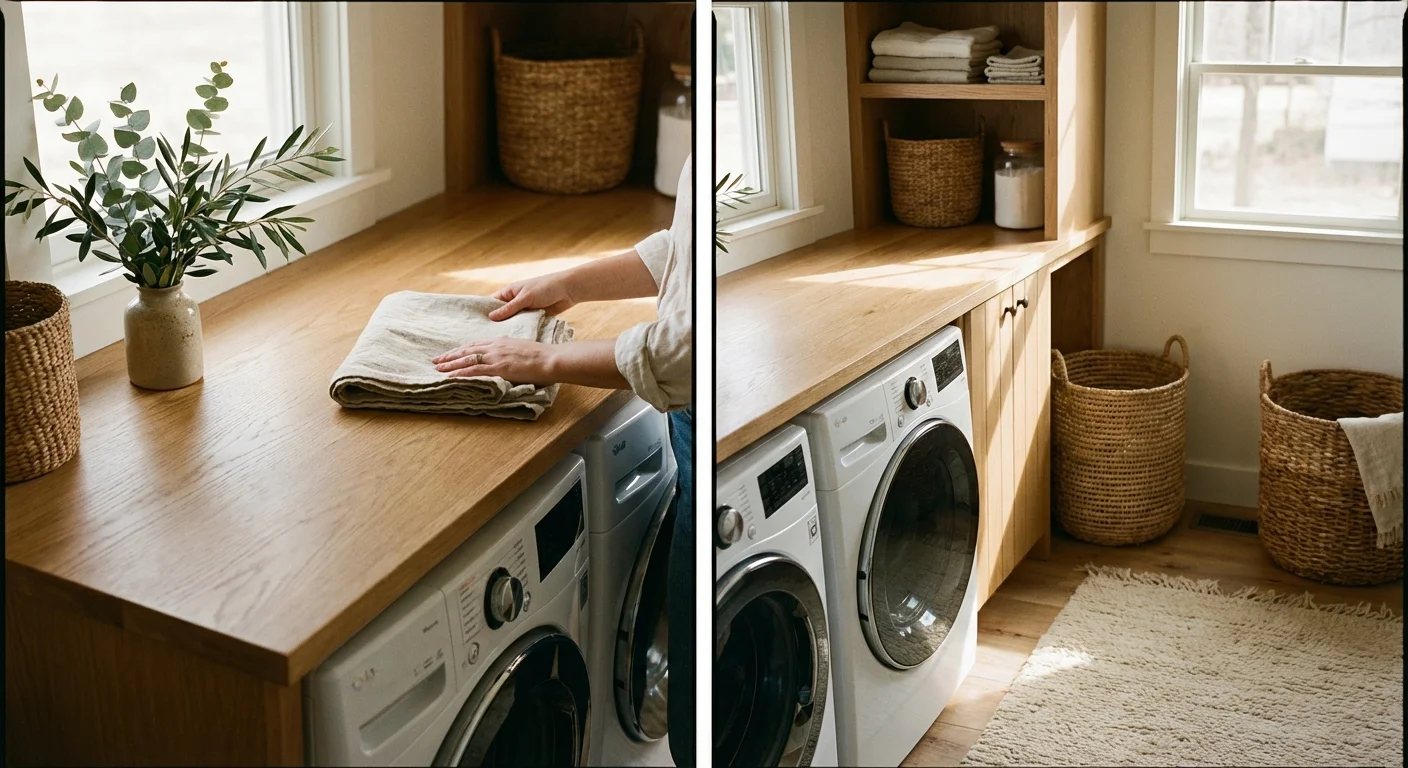
Top-loaders need clear space above for the lid, so a fixed counter won’t work. Mount a drop-leaf table on the opposite wall instead; it folds flat when you’re done.
For drying, skip bulky floor racks. A fold-down accordion rack or retractable clothesline on a free wall disappears when not in use.
A recessed ironing board cabinet fits between studs and closes flush. Laundry walls often hide water lines, wiring and the dryer duct, so use a stud and wire finder and check from the other side before cutting.
If anything runs through that bay, use an over-door ironing board hanger.
What to decant and what to leave in the original bottle
Uniform containers look calmer than mismatched jugs, but some products should never leave their packaging. A review of laundry capsule poisonings found 60% of pediatric cases occurred when packets had been removed from their original containers.
| Storage method | Best for | Trade-off |
|---|---|---|
| Original container | Pods, bleach, rust and stain removers, bulk liquid jugs | Keeps child-resistant closures, dosing caps and warnings; looks busier |
| Labeled jar or bin | Powder detergent, oxygen booster, dryer balls, clothespins, spare buttons | Needs refilling and a label with the product name; keep out of reach |
| Hybrid | Most households | Original bottles grouped in opaque bins labeled “Stain treatment,” “Detergents” and “Machine care” |
Detergents, pods, bleach and stain removers can cause serious harm if children reach them, so in homes with young kids, store them in a latched cabinet or on the top shelf, closed. Never put any laundry product in a cup, food jar or drink bottle.
The hybrid approach gives the clean look without the risk: show only items worth seeing and hide the rest in closed bins. Our comparison of clear versus fabric bins helps pick which is which.
Fitting the system into a closet-sized nook
Take a 60-inch-wide, 30-inch-deep rental hallway closet with bifold doors. Stacking two 24-inch compact front-loaders leaves 36 inches of width beside the stack.
After an inch of clearance on each side, about 34 inches remain for a 12-inch-deep tall cabinet or a rolling cart plus a wall rail of sorting bags.
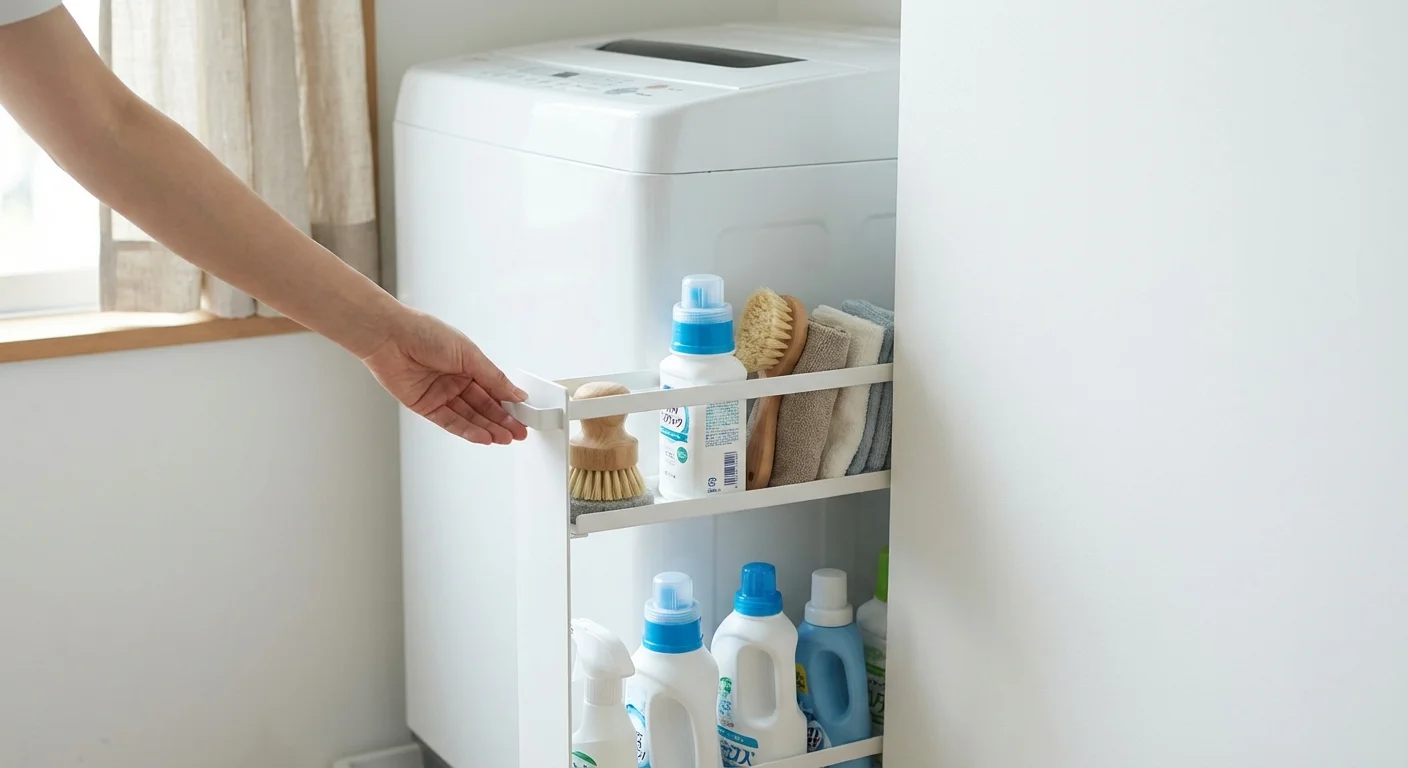
Stack only machines the maker approves, using the manufacturer’s stacking kit and its minimum clearances. Bifold doors won’t take an over-door rack, so put door-style storage on the closet’s side wall instead.
Because it’s a rental, get the landlord’s approval before stacking machines or anchoring a rail. A freestanding cabinet and rolling cart need no holes at all.
Keep the main hampers in bedrooms and bring laundry to the closet only to run a load. That keeps the hallway passable.
If the closet has no exterior wall for a duct, an ENERGY STAR heat pump dryer runs ventless, with no exterior ducting. Check its installation requirements before buying.
Light, wall finishes and dryer safety
Daylight-balanced LED bulbs in the 4000K to 5000K range make set-in stains easier to see than dim, warm light. Battery-powered puck or strip lights under shelves light the folding surface without wiring.
Turn off the breaker before swapping a ceiling fixture, and call a licensed electrician for new circuits or outlets. Paint walls in satin or semi-gloss so lint and splashes wipe off; luxury vinyl plank or tile handles leaks better than laminate.
Clean the lint filter before every load, since failure to clean lint filters and vents is the leading cause of home dryer fires. Use rigid or flexible metal duct and keep the area around the dryer clear of combustibles like stacked baskets and rags.
Don’t push the dryer so far back that the duct crushes, and don’t box machines in tight cabinets without the clearances their manuals list. Run an exhaust fan or crack a window while drying; if musty spots appear, follow our mold removal guide.
Monthly checks for the laundry room
- Run the washer’s cleaning cycle and wipe the door gasket and detergent drawer.
- Vacuum behind and beside the machines, where lint and lost socks collect.
- Wipe detergent drips from bins, shelves and the cart.
- Look over the dryer duct for kinks or crushing.
For the machines themselves, our appliance deep-cleaning guide covers washer odors and dryer drum care step by step.







1 Comment
Comments are closed.